Signs Your AC May Be Low on Refrigerant: What to Check
Spot low AC refrigerant signs, what to check safely, and why refrigerant leaks need licensed HVAC repair before compressor damage starts.
Articles on this site may include sponsored content. If they do, it's labeled clearly - and it still has to answer a real homeowner question. Same bar as everything else here.
How to Tell If Your AC Is Low on Refrigerant
Your AC is running. You can hear the outdoor unit humming. But the air coming out of the vents is barely cool - it’s more like a gentle exhale than the blast of cold you’re used to. You walk outside and notice the big copper line going into the compressor has a layer of frost on it, even though it’s 90°F out. And your last electric bill? Let’s just say it got your attention.
If this sounds familiar, there’s a good chance your AC is low on refrigerant.
Refrigerant is the lifeblood of your air conditioner - the stuff that absorbs heat from inside your home and releases it outside. When the charge is correct, your AC works quietly and efficiently. When it drops, everything goes sideways. The system can’t move heat the way it was designed to, and eventually, it starts damaging itself from the inside.
The tricky part? Low refrigerant shares symptoms with several other problems - a dirty filter, a bad capacitor, a stuck contactor. So before you call someone, it helps to know what you’re actually looking at. This guide walks you through the signs, the causes, and what to do next.
Quick Answers
Q: What’s the most obvious sign my AC is low on refrigerant?
Warm air blowing from the supply vents when the system should be cooling is the most common sign. If your AC runs continuously but the air coming out feels only slightly cool - or room temperature - refrigerant is the likely culprit.
Q: Can I just add more refrigerant myself?
No. Refrigerant doesn’t get “used up” like gas in a car. If you’re low, you have a leak - and adding more without fixing the leak just means you’ll be low again in a few weeks. DIY refrigerant cans are available at hardware stores, but they’re dangerous, illegal to use without a license in most situations, and won’t solve the actual problem.
Q: Is low refrigerant an emergency?
Not a house-fire emergency, but yes, you should address it promptly. Running an AC with low refrigerant will eventually destroy the compressor - the most expensive component to replace. The longer you wait, the more damage accumulates.
The signs you can spot yourself
You don’t need gauges, a multimeter, or a certification to identify most refrigerant problems. A few minutes of observation tells you a lot.
Warm or lukewarm air from the vents
This is the one that gets most people’s attention. You set the thermostat to 72, the system kicks on, and the air coming out of the registers feels - okay, I guess? Not cold. Not even cool, really. Just moving air.
A properly functioning AC should deliver supply air that’s 15-20°F cooler than the air entering the return. If the temperature difference is smaller than that, the system isn’t removing heat effectively. Low refrigerant is the most common cause, but not the only one - a dirty coil or a failing compressor can produce the same symptom. The spring AC checklist covers the basic cleaning and startup checks that can rule out simpler causes.
The test is simple: hold a thermometer in a supply vent (the ones blowing air into the room) and another near the return grille (the big one sucking air in). If the difference is less than 14°F on a hot day, something is off.
Ice or frost on the copper lines
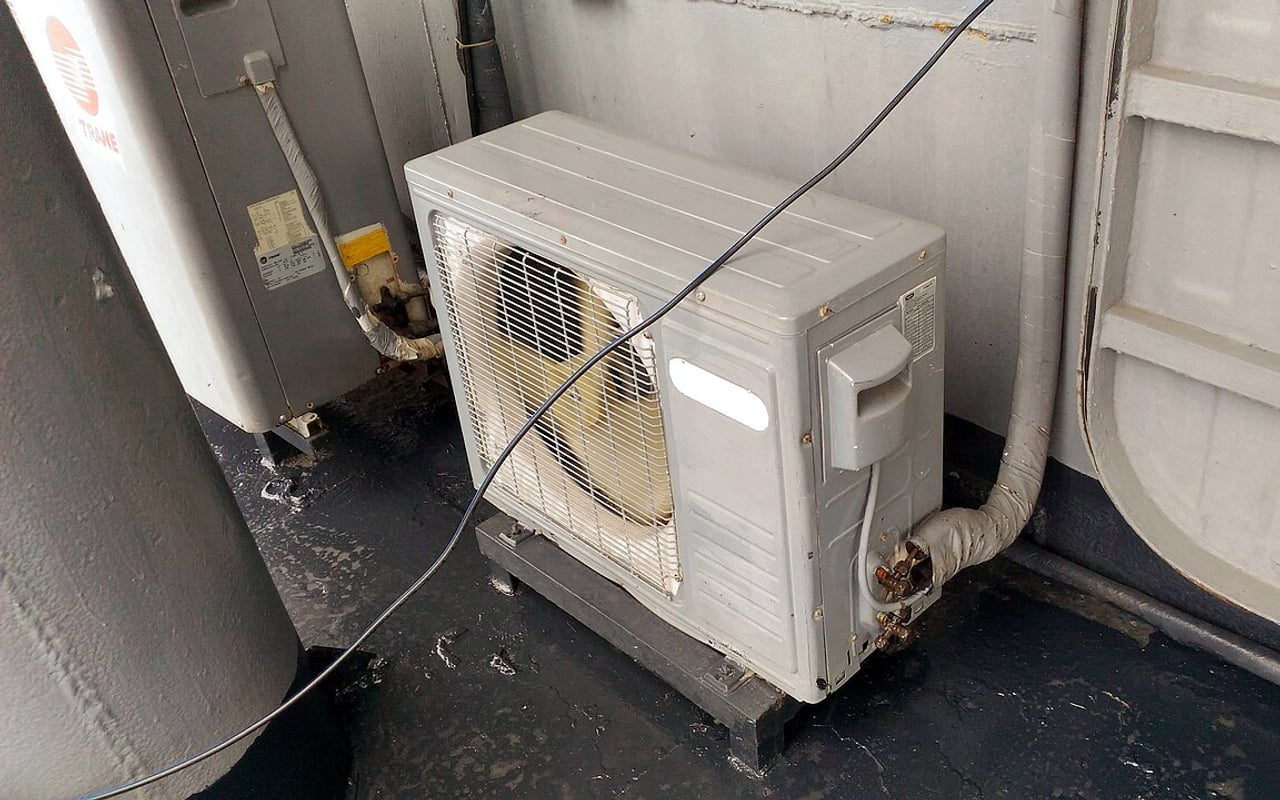
Walk outside and look at the copper lines connecting your outdoor unit to the house. There are two of them - one smaller (the liquid line) and one larger (the suction line), wrapped in black foam insulation. If you see frost or ice on the larger line, the fitting, or the outdoor unit valve, that’s a strong refrigerant signal.
Here’s the physics: low refrigerant causes the pressure in the evaporator coil to drop. Lower pressure means the refrigerant gets colder than it should - cold enough to freeze the moisture condensing on the coil and the suction line. That ice then acts as an insulator, making heat transfer even worse, which makes the refrigerant even colder, which creates more ice. It’s a self-reinforcing spiral.
Important: ice can also form from restricted airflow - a dirty filter or a blower motor running slow. So check your filter first. If you are not sure what a clogged filter can do, start with the HVAC filter change guide. If the filter is clean and the airflow seems normal but there’s still ice, refrigerant is the likely cause.
Hissing or bubbling sounds
Refrigerant moves through the system as a mix of liquid and gas under pressure. When there’s a leak, you can sometimes hear it. A steady hissing sound from the indoor unit or the outdoor unit suggests refrigerant escaping from a small hole or crack. A bubbling or gurgling sound - especially after the system shuts off - can mean the refrigerant is boiling inside the coil because the pressure is too low.
These sounds are more noticeable at night when the house is quiet. If you stand near the air handler (usually in the attic, basement, or closet) and hear something that sounds like a slow leak, you’ve likely found your problem.
Short cycling
Low refrigerant is one of the causes covered in the short cycling guide. Many modern AC systems have a low-pressure safety switch that shuts the compressor off when the refrigerant pressure drops too low. The compressor starts, the pressure drops, the switch trips, the compressor stops. A few minutes later, it resets and tries again - and the cycle repeats.
This isn’t just a comfort issue. Every start-up stresses the compressor. Short cycling from low refrigerant can kill a compressor in a season.
Higher electric bills
This one is sneaky because it creeps up gradually. When refrigerant is low, the system has to run longer and work harder to move the same amount of heat. It might run for hours without ever satisfying the thermostat. That extended run time consumes more electricity. If you are trying to separate low refrigerant from normal extreme-weather runtime, use the AC running constantly guide as the first pass.
Compare your current bill to the same month last year. If usage is up 20-30% without a corresponding change in weather or thermostat settings, your system is working too hard - and low refrigerant is one possible reason. If comfort problems show up as sticky air instead of warm supply air, use the humid house with AC on guide to check the humidity side of the problem.
Quick Answers
Q: Can a refrigerant leak make my AC stop working entirely?
Eventually, yes. As the charge continues to drop, the system reaches a point where it can’t maintain enough pressure to operate. The low-pressure switch (if you have one) will lock out the compressor permanently. At that point, you get nothing - just warm air and a flashing thermostat.
Why refrigerant gets low in the first place
Refrigerant doesn’t wear out. It doesn’t evaporate. It doesn’t get consumed during normal operation. A sealed AC system should hold the same charge for the life of the equipment.
The only way to lose refrigerant is through a leak.
Age and vibration
Copper lines vibrate when the compressor runs. Over decades, that vibration can cause hairline cracks at the fittings - especially where the line set connects to the service valves. These cracks are often invisible to the naked eye but big enough to let refrigerant escape slowly.
Factory defects
It happens. A coil arrives with a pinhole from the manufacturing process. A fitting wasn’t brazed properly. A Schrader valve core (the little valve inside the service port, like the one on a tire) was loose from the factory. These defects usually show up in the first year or two of operation, which is why the manufacturer’s warranty covers them.
Corrosion
This is a big one in coastal areas and places where road salt is common. The aluminum fins on the outdoor coil can corrode, forming pinhole leaks that are nearly impossible to find without electronic leak detection equipment. The same thing can happen to the indoor coil - especially in systems where the evaporator coil is made of aluminum instead of copper.
Physical damage
A lawnmower throwing a rock into the condenser coil. A tree branch falling on the line set. Someone bumping the copper lines while working in the attic. Accidents happen, and when they involve refrigerant lines, the result is a leak.
Quick Answers
Q: How fast does refrigerant leak out?
It depends on the size of the leak. A slow leak - like a pinhole in the evaporator coil - can take a year or more to drop the charge low enough to cause symptoms. A fast leak - like a line set cut by a weed whacker - can dump the entire charge in hours. Most residential leaks are slow, which is why homeowners often don’t notice until the system is significantly undercharged.
Q: Should I try leak sealant products?
I advise against them. Leak sealants (the kind you inject into the system) are a band-aid at best and a system-killer at worst. The sealant can clog the expansion valve, the metering device, or the compressor oil passages - causing a failure that’s more expensive than the original leak repair.
What to do if you suspect low refrigerant
You’ve got the signs. You’ve checked the filter. You’ve confirmed the airflow is normal. The ice is still there, the air is still warm, and the electric bill is still climbing. Now what?
Turn the system off
If you see ice on the lines or the coil, turn the AC off at the thermostat and at the breaker. Running the system with ice on the coil can damage the compressor. Let everything thaw completely - this can take several hours - before you have a technician look at it.
Running a frozen AC is like driving a car with the emergency brake on. You’re forcing the system to fight against itself, and the compressor is taking the hit.
Call a licensed HVAC contractor
This is not a DIY repair. Refrigerant handling requires EPA certification in the United States. The equipment to find and repair leaks - electronic leak detectors, nitrogen tanks, vacuum pumps - is specialized and expensive. And the risks include frostbite (refrigerant is extremely cold when it escapes), asphyxiation (it displaces oxygen in confined spaces), and compressor damage from improper charging.
Before you choose someone, the HVAC contractor questions guide can help you separate a real leak diagnosis from a quick top-off pitch. When you call, tell them what you’ve observed:
- The supply air temperature (or the temperature split)
- Whether you see ice on the lines
- Whether you hear any hissing sounds
- How long the system has been acting up
- Whether it’s short cycling
This information helps the technician bring the right equipment and estimate the job accurately.
Understand the repair options
A refrigerant leak repair typically involves three steps: find the leak, fix the leak, and recharge the system. Depending on the location and severity, the fix can be straightforward or expensive.
Small leak at a fitting: A technician can often tighten the fitting, replace the Schrader valve, or re-braze the joint. This is usually the cheapest scenario - a few hundred dollars including labor and refrigerant.
Leak in the evaporator coil: This is the most common leak location, and the most expensive to fix. The evaporator coil is inside the air handler, usually in the attic or basement. Accessing it requires disconnecting refrigerant lines, removing the coil, installing a new one, and recharging the system. Cost: typically $800-2,000 depending on access and coil type. For context on urgent service pricing, compare it with the emergency HVAC repair cost guide.
Leak in the condenser coil: The outdoor coil can sometimes be patched if the leak is accessible. But patches are unreliable on aluminum coils, and most contractors will recommend replacing the entire outdoor unit or just the coil. If the system is older than 10-12 years, replacing the whole system often makes more financial sense than repairing the coil. The HVAC system lifespan guide can help you decide whether the age of the system changes the repair math.
Know when to walk away
Here’s the honest truth that salespeople won’t tell you: if your system is more than 12-15 years old and you have a refrigerant leak, it’s often smarter to replace the whole system than to repair it.
Why? Because R-410A (the refrigerant in most modern systems) is being phased down under the AIM Act. Prices are rising. Availability is shrinking. And an older system with one leak is likely to develop more leaks as the rest of the coil ages. The repair cost might get you one more summer - or it might get you three weeks before the next leak appears.
A replacement is expensive upfront, but you get a new compressor, a new coil, a warranty, and a system designed for the refrigerants that will be available for the next 10-15 years. Before approving that path, read the HVAC replacement quote guide and the HVAC warranty terms guide so you know what the proposal actually includes.
Quick Answers
Q: How much does it cost to recharge an AC system?
A simple recharge (find leak, fix it, refill) typically costs $200-600 for labor and refrigerant. But “just refilling” without fixing the leak is a waste of money - the refrigerant will leak out again. Always insist on a leak search before anyone adds refrigerant.
Q: Can low refrigerant cause health problems?
Indirectly, yes. A system with low refrigerant can’t dehumidify properly, which means your home stays damp. High indoor humidity promotes mold, dust mites, and bacteria - all of which can trigger allergies and respiratory issues. The refrigerant itself is not a health concern unless there’s a massive leak in an enclosed space, which is extremely rare in residential systems.
Quick Answers
Q: Does my home warranty cover refrigerant leaks?
It depends on your policy. Many home warranty plans cover refrigerant leaks and recharges, but they often have caps ($500-1,000 per repair) and exclusions (pre-existing conditions, corrosion). Read your contract carefully before filing a claim - and be aware that home warranty companies sometimes use the cheapest possible contractor, which can mean a subpar repair.
Q: Will a refrigerant leak always cause ice?
No. Mildly low refrigerant might not produce visible ice - the system just runs poorly. Ice usually appears when the charge is significantly low (30-40% below spec). If you have a slow leak that hasn’t dropped the charge that far, you might notice warm air and high bills without ever seeing ice.